Brecher Brief
Brecher Brief

Search

Category

Archives

Recent Entries

Syndicate this site (XML)

Powered by

Movable Type 3.17


January 30, 2012

Austerity and the "Common Sense" Fallacy

One of the more aggravating conditions of public discourse is the emotional appeal—and hence, political appeal—of “common sense,” however foolish or misguided that common sense turns out to be. This is especially evident in debates over economic policy where the “common sense” approach always seems to argue for deficit reduction and austerity. In a famous debate moment from the ’92 election, for instance, a young African American woman asked what turned out to be the campaign’s defining question: “how has the national debt affected you personally?” While HW Bush stammered something about interest rates and glanced impatiently at his watch, Clinton hit the ball out of the park, assuring the woman that he felt her pain. Clinton understood what Bush didn’t: the question was really about the recession, job loss, and economic uncertainty. Debt and deficit were only the language she used to articulate those fears.

For average citizens, treating government debt as a synonym for economic turbulence makes perfect sense. After all, when individual families get into financial trouble it is often because they have piled up too much credit card debt. And when somebody loses their job, the last thing they ought to do is whip out their credit card and go on a spending spree. Even if taking on more debt winds up being the necessary evil that allows them to avoid starvation for a few more days, it is rarely thought of as a “solution.” So when a society goes into an economic tailspin, common sense argues that we extrapolate from personal experience. Hence it “seems” only obvious that the solution is government belt-tightening.
But whole societies and their governments are not individual families. Analogies that equate them are often stupid and sometimes dangerous. Still, some economists and politicians persist in doing it. Consequently, we get the conservative fetish for deficit reduction in The United States, and the even more tragic mania for “austerity” that is now driving Europe over the abyss (while threatening our own fragile recovery). Case in point: Great Briton's suicidal efforts at reform through austerity.

Laying out the case in his column today, Paul Krugman writes:

Last week the National Institute of Economic and Social Research, a British think tank, released a startling chart comparing the current slump with past recessions and recoveries. It turns out that by one important measure — changes in real G.D.P. since the recession began — Britain is doing worse this time than it did during the Great Depression. Four years into the Depression, British G.D.P. had regained its previous peak; four years after the Great Recession began, Britain is nowhere close to regaining its lost ground.


Nor is Britain unique. Italy is also doing worse than it did in the 1930s — and with Spain clearly headed for a double-dip recession, that makes three of Europe’s big five economies members of the worse-than club. Yes, there are some caveats and complications. But this nonetheless represents a stunning failure of policy.

And it’s a failure, in particular, of the austerity doctrine that has dominated elite policy discussion both in Europe and, to a large extent, in the United States for the past two years.

His conclusion is especialy troubling:

The infuriating thing about this tragedy is that it was completely unnecessary. Half a century ago, any economist — or for that matter any undergraduate who had read Paul Samuelson’s textbook “Economics” — could have told you that austerity in the face of depression was a very bad idea. But policy makers, pundits and, I’m sorry to say, many economists decided, largely for political reasons, to forget what they used to know. And millions of workers are paying the price for their willful amnesia.

But half a century ago, things were different. Politicians who wished to pander to the misguided “common sense” fears of average voters could not so easily depend on theoretical support from a coterie of professional economists who take Austrian theory as an article of faith (evidence be damned); neither were they so liberally funded by a corporate class for whom the power to exploit was no longer a sin to be rationalized, but a sacred liberty to protect. And when sincere ignorance, self-interest, and piety collude, can any virtue be safe?


Posted by stevemack at 09:00 AM | Comments (0)

January 18, 2012

The Politics of "Job Cremation"

Last week Nate Silver weighed in on the question over whether the current attack on Romney’s Bain Capital history will exhaust itself by the general election. Some speculate that by tarring him as a “Vulture Capitalist,” Gingrich, Perry and others are actually doing him a favor—in essence, inoculating him against the same charge when Obama makes it. The argument goes that, aired now, the attack becomes old news later on; moreover, Romney now has six months or more to practice his response.

Could be, but Silver doesn’t think so—and neither do I.
Silver's first and most significant point is that the charge has the potential of undermining Romney’s “brand” as a job creator—the professional identity that functions as the fundamental argument for his candidacy:

Mr. Romney has made his private-sector experience a major theme of his campaign, using it to form a contrast to the “career politicians” he is running against in the primary as well as to Mr. Obama. “I think to create jobs it helps to have had a job,” Mr. Romney has said repeatedly. He has argued for less government regulation of private enterprise, and has said he would repeal new regulations on financial companies.

It would be one thing if the substance of the attacks on Mr. Romney had to do with an ethical problem at Bain Capital or some type of personal association. This is not to say that voters would have no right to consider the issue, but it would be somewhat peripheral to the core economic message of Mr. Romney’s campaign.

But these attacks take a different tack. They are a critique of Bain Capital’s business model and, by extension, a critique of a certain form of free-market activity that Mr. Romney and other Republicans advocate.

Ads like “When Mitt Romney Came to Town,” the 28-minute commercial put out by a “super PAC” that backs Newt Gingrich, adopt what appears to be a documentary style, but they present a one-sided view of the role played by private equity companies like Bain Capital, characterizing them as greedy and as lining the pockets of the wealthy at the expense of the working class. Were it not for the couple of clips of Mr. Romney speaking French, one would be shocked to learn that the ads had been produced by Republicans, rather than by a liberal filmmaker.

Arguments over job creation are going to be central to this year’s general election. It will be harder for Mr. Romney to defend his laissez-faire positions if Democrats can roll out clips of Republican partisans attacking him. Already, Gov. Rick Perry of Texas, the former head of the Republican Governors Association, has described Mr. Romney as a “vulture capitalist.” Newt Gingrich, the former speaker of the House, has said that Bain Capital has an “indefensible” business model.

It will not be above Mr. Obama’s campaign to simply replay clips of Mr. Gingrich and Mr. Perry making these remarks. Successful presidential campaigns have used such a tactic before. In 1980, for instance, Ronald Reagan’s campaign released a commercial that consisted of nothing more than a 25-second clip of a Ted Kennedy speech, in which Mr. Kennedy scolded the incumbent Democratic president, Jimmy Carter, on the Iranian hostage crisis and the country’s high inflation rates.

If the campaign is “merely” about job-creation competency, than Silver is, at least potentially, correct. But if liberals succeed in making the election a referendum on laissez-faire capitalism, if Obama makes the argument for the kind of mixed economy we’ve had for the last eighty years (an argument that has actually never been made in an election), and if Romney becomes the poster boy for the sort of rigid, draconian, “Austrian” economics that conservatives have championed since 1980, then Silver has actually understated the case and the Bain brand could be lethal.
Personalized attacks of this sort succeed when they resonate with a larger narrative. And if that larger narrative becomes, in effect, the organizing principle of the entire election, then such charges become self-validating. It will come down to whether or not liberals will be able to pin the global economic downturn, radical—and worsening—inequality, and the sluggish recovery on Austrian economics, and by extension, Romney’s often predatory business practices legitimized by that theory.

Few will be moved by claims of business expertise when one's business is, as the DNC puts it, "job cremation."

Posted by stevemack at 09:41 AM | Comments (0)

January 13, 2012

The Decline of the Public Intellectual

Surely the Russian masses (such a crude and ugly word) of a century ago were no more attentive to their intellectuals, public or otherwise, than we are today. And to hear American intellectuals tell it, that’s setting the bar pretty low.

Giving expression to a certain kind of anxiety of influence has become a clichéd preoccupation of public intellectuals in the last two decades. Not Harold Bloom’s creativity triggering anxiety, but a more pedestrian sort of whining about their apparent inability to exert any influence in the public square.

Continue reading "The Decline of the Public Intellectual"

Posted by stevemack at 09:24 PM | Comments (0)

The Wicked Paradox: The Cleric as Public Intellectual

If there’s any truth to the old adage that religion and (liberal, democratic) politics don’t mix, it isn’t because they are polar opposites—an ideological oil reacting against a metaphysical water. Rather, it’s because they are, more or less, alienated kindred vying for the same space in the human imagination. It is not difficult to see why: religious experience and democratic politics make overlapping—and often competing—claims to the deepest meanings we attach to our humanity. First, both make a sacred obsession of the operations of individual conscience. Whether it is in the prayer tower or the voting booth, each pivots on a private, solemn, even mystical moment when the individual summons all the resources of their inner being in a single act of “self-transcendence.” Second, both religion and democracy draw the individual into a larger cosmic or social order—then define obligations that go along with one’s place in that order. Both, in other words, offer a vision of personal identity that is derived from beliefs about how we should relate to everything around us. The struggle between the spiritual and political forces of our imagination is older than such things as red states, the Christian Coalition, or the Moral Majority. It’s been a continuing drama for nearly four hundred years of American history. But following the 2004 reelection of George W. Bush, the old drama acquired a new cast of characters and a snappy new production.

Continue reading "The Wicked Paradox: The Cleric as Public Intellectual"

Posted by stevemack at 09:18 PM | Comments (0)


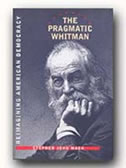
"A Whitman for our Time."
- Jerome Loving,
   ORDER
"Stephen John Mack's The Pragmatic Whitman: Reimagining American Democracy, [is] The most thoroughly informed philosophical reading of Whitman to appear in decades. Mack develops the premise . . . That Whitman shares with John Dewey a vision of democracy as a 'civic religion' in America, a profoundly secularist and progressive perspective."

- M. Jimmie Killingsworth, Texas A & M University
January 2012
Sun Mon Tue Wed Thu Fri Sat
1 2 3 4 5 6 7
8 9 10 11 12 13 14
15 16 17 18 19 20 21
22 23 24 25 26 27 28
29 30 31